What Documentation Does the Tax Office Require for the Forschungszulage

What Documentation Does the Tax Office Require for the Forschungszulage (R&D Tax Credit)? From Timesheets and Payroll Records to Contract Research and Project Status
Dr. Anne Küsters, October 26th, 2026
The most important documentation for the German R&D tax credit is often not uploaded with the application at all. The application is submitted electronically through Mein ELSTER. In principle, no supporting documents need to be attached. This does not mean, however, that companies can dispense with documentation. During its review, the tax office may request evidence and will then expect the claimed R&D expenditure to be traceable and substantiated.
For start-ups, the priority is therefore not to produce as many documents as possible. It is to document the R&D project clearly enough that the time worked and costs incurred can later be allocated, traced and evidenced.
The BSFZ reviews the project. The tax office reviews the costs.
The R&D tax credit involves two separate reviews. First, the BSFZ assesses whether the project qualifies as research and development within the meaning of the German Research Allowance Act (Forschungszulagengesetz, FZulG). If the certificate is positive, it is generally transmitted directly to the responsible tax office. The financial review then begins.
After the end of the relevant financial year, companies apply to the tax office for the eligible expenditure actually incurred. Section 5 FZulG requires R&D projects and the associated expenditure to be specified in sufficient detail to allow verification. The BSFZ therefore primarily answers the question: Does this qualify as an eligible R&D project? The tax office then answers: Which eligible costs were actually incurred in this financial year? Robust documentation is needed for precisely this second question.
For personnel costs, it is not just salary that matters, but the R&D share
For many software, AI and deep-tech start-ups, personnel costs are the largest cost category in the R&D tax credit. The tax office must therefore be able to determine which employees worked on the eligible R&D project and what proportion of their working time was actually attributable to those activities.
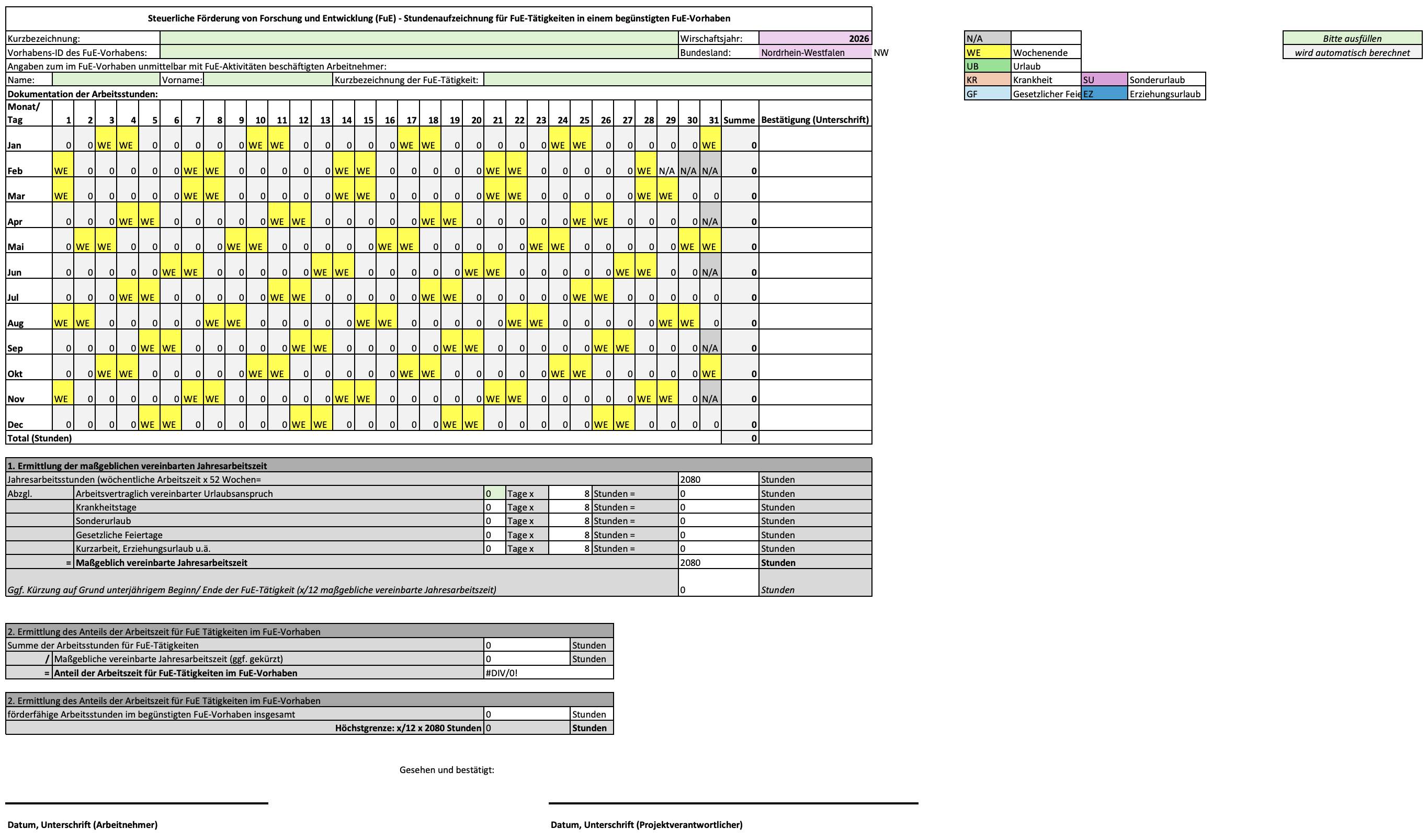
According to the German Federal Ministry of Finance, companies should retain, in particular, the payroll records of employees working on the project, as well as individual records of their work assignments. The documentation must make it possible to trace the link between each employee, the R&D project and the time worked.
The Ministry provides its own timesheet template for this purpose. Crucially, however, using this specific template is optional. Companies may use other systems, provided the records are comprehensible and auditable. Electronic records are equally acceptable, as is paper-based documentation.
For a start-up, this means in practice: a Jira ticket alone does not replace a reliable allocation of working time. At the same time, there is no need for a complex grant-management system. The documentation needs to show who worked on which eligible R&D project, when, and to what extent.
Learn more: How do you calculate costs for the Forschungszulage?
Contract research requires a traceable agreement
For external development partners, documentation does not end with the invoice. For contract research, the client must be able to substantiate the amount and origin of the claimed expenditure with appropriate records. According to the Ministry of Finance guidance, this includes, in particular, the agreement between client and contractor, which must be available to the tax office upon request. The agreement should therefore reflect the project’s actual structure.
For example, if a company engages an external engineering partner for a clearly defined R&D work package, the records should make clear which technical task is being performed and which costs arise from it. A generic invoice for “software development” establishes this link only to a limited extent.
For R&D projects commissioned after 27 March 2024, 70% of the remuneration incurred is generally recognised as eligible expenditure. The underlying cost base must nevertheless be documented in a traceable manner.
For machinery and hardware, costs and use must align
For hardware, robotics and advanced-manufacturing companies, certain movable assets may also be relevant. Subject to the statutory requirements, the depreciation of an asset may be considered where it is necessary for the R&D project and used exclusively for the company’s own R&D activities. Here, too, the documentation should follow a clear logic.
Which asset was acquired or produced? What depreciation is being claimed? In which R&D project is it used? Why is it required for that project? During the BSFZ process, relevant assets may also need to be assigned to the project and the corresponding sections of the work plan.
The new overhead allowance does not require tracking every individual indirect expense
For R&D projects beginning after 31 December 2025, an additional flat-rate allowance of 20% of the other eligible expenditure is recognised for overhead and operating costs. The point of the allowance is precisely that these costs do not have to be individually allocated to the research project. Companies therefore do not need to break down every share of office, administrative or other indirect costs for each R&D project.
What matters instead is that the underlying eligible expenditure has been determined correctly. The allowance is calculated on that basis.
What many companies overlook: project status at year-end
The R&D tax credit is claimed on a financial-year basis. In a multi-year development project, it is therefore not enough to create documentation only once the entire project has been completed. In the event of an audit, the Ministry of Finance requires traceable records of how eligible expenditure was determined and of the R&D project’s status at the end of each financial year. This may include a brief description of the work completed by that point and the project’s progress.
According to the Ministry of Finance guidance, no final documentation of all research results is required at the end of the R&D project. The objective is therefore not to write a scientific final report for the tax office; it is to ensure traceability.
Good documentation is created during development
The most common mistake is not a missing form. It is trying to reconstruct the reality of a project two years later from calendars, tickets, invoices and memory.
This is especially relevant for start-ups, where an R&D project can change quickly. Employees move between work packages. A technical approach is discarded. External specialists join the project. A prototype evolves into the next product generation.
If these changes are documented properly as the project progresses, calculating the claim later becomes significantly easier.
The best R&D tax credit documentation is not an additional bureaucracy process. It is a traceable connection between the technical work and the costs it generates. Ultimately, that is what the tax office must be able to see.
Assess Your R&D Project with DnA
You know your product. Your team knows the technical hurdles. The next step is turning that work into a clear assessment of its funding potential. t DnA Ventures, we combine the perspective of an early-stage investor with industrial and technology expertise. Our focus is Industrial and Deep Tech, and the companies building new technical solutions. For the German R&D tax credit, we support companies from the initial eligibility assessment through preparation and drafting of the application and into the subsequent funding process.
The goal is not to dress up your project in funding terminology. It is to make the technical substance of what you are building clear and defensible.
Tell us what you are developing, which technical questions remain unresolved, and how your team is approaching them. Together, we assess the potential R&D tax credit opportunity and the next steps.
Check your project’s eligibility →
About DnA Ventures
Built from industry, for industry: DnA Ventures combines industrial and startup experience with venture capital and non-dilutive R&D funding. For an initial R&D tax credit eligibility assessment, contact Anna Saari.
Disclaimer: This article provides general information and does not constitute tax or legal advice. Actual eligibility and the amount of the R&D tax credit depend on the individual circumstances.

Related
topics.
Explore additional articles on the Forschungszulage to deepen your understanding of eligibility, application strategy, and funding updates.