


How to Calculate the Forschungszulage: Costs Explained

How to Calculate the Forschungszulage (German R&D Tax Credit): Eligible Costs Explained
Dr. Anne Küsters, September 25th, 2026
How much German R&D tax credit can a company actually receive? The short answer sounds simple. Germany’s R&D tax credit, the Forschungszulage, generally amounts to 25% of the eligible assessment base. Small and medium-sized enterprises that meet the relevant EU SME definition can apply for an increased rate of 35%. Since 2026, the maximum assessment base has been €12 million per financial year. This results in a maximum R&D tax credit of €3 million, or up to €4.2 million for qualifying SMEs.
In practice, however, the calculation is rarely as simple as “project budget × 35%”. What matters is not how much the development project costs in total. The key question is which part of those costs qualifies as eligible R&D expenditure and can actually be allocated to an eligible research and development project.
For startups, this distinction can make a significant difference. Developer salaries may only qualify in part. External development is treated differently from internal personnel. Machinery is not simply included at its full purchase price. And since 2026, newly started R&D projects can also benefit from an additional allowance for overhead and operating costs. If you want to calculate your R&D tax credit realistically, start with the individual cost categories, not the overall project budget.
Which Costs Can Be Included in the German Forschungszulage?
For technology companies, four cost categories are particularly relevant: internal personnel costs, contract R&D, certain depreciation costs for eligible assets, and since 2026, the new allowance for overhead and operating costs. The German R&D Tax Credit Act defines these categories relatively precisely. For internal employees, wages and certain employer contributions can be included to the extent that the employees are actually working on an eligible R&D project.
For contract R&D commissioned from March 28, 2024 onwards, 70% of the relevant contract value is generally included as eligible expenditure. Under certain conditions, depreciation on movable fixed assets can also qualify. For R&D projects beginning after December 31, 2025, an additional 20% of the other eligible expenditure is included as a flat-rate allowance for overhead and operating costs.
This is where a seemingly simple funding rate becomes an actual R&D cost calculation.

Personnel Costs: The Biggest Lever for Many Startups
For software, AI, and Deep Tech startups, people often account for the largest share of R&D spending. That is good news, because personnel costs are also one of the central components of the German R&D tax credit. Relevant wages and certain employer contributions can generally qualify, but only to the extent that the employee actually works on the eligible R&D project.
A Machine Learning engineer with annual relevant personnel costs of €80,000 therefore does not automatically create an assessment base of €80,000. If that person spends 60% of their relevant working time on the eligible R&D project, the calculation first allocates the corresponding share of personnel costs. With €80,000 in annual personnel costs and a documented R&D share of 60%, the eligible amount is €48,000. For a qualifying SME, 35% of that amount would initially result in an R&D tax credit of €16,800, before other eligible cost categories and the 2026 overhead allowance are taken into account. The key variable is therefore not only salary. It is how much of the employee’s actual working time can be clearly allocated to the eligible R&D project.
A simple example
Consider a software startup developing a new industrial AI solution. One developer generates total relevant personnel costs of €72,000 per year, including eligible employer contributions. She spends 50% of her relevant working time on the R&D project. That means €36,000 of her personnel costs can be allocated to the project. At an SME funding rate of 35%, this corresponds to €12,600 in R&D tax credit for this cost block.
The logic matters more than the specific number: Personnel costs × actual R&D share = eligible personnel expenditure Only then is the applicable R&D tax credit rate applied.

Why Time Tracking Matters for the Cost Calculation
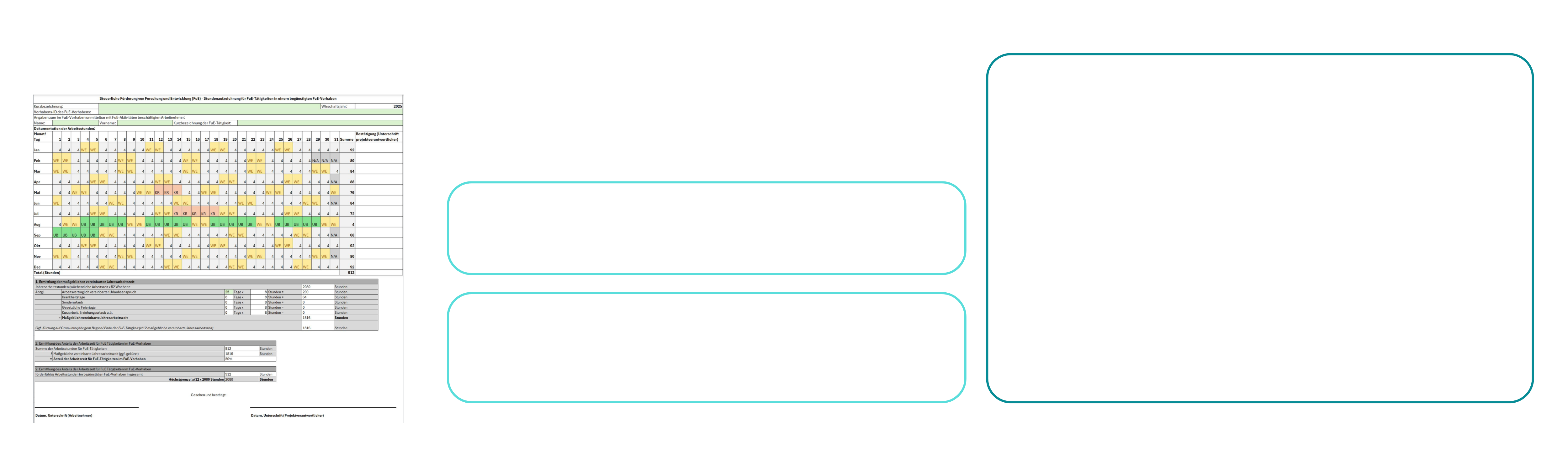
For retrospective applications, one of the most common challenges is not the formula. It is the data behind it. For the final tax assessment, it is not enough to say that an engineer spent “roughly half of their time” on R&D. The expenditure claimed must be plausible and traceable.
The actual R&D working time therefore needs to be compared with the employee’s relevant annual working time. Vacation, sick leave, public holidays, and other absences need to be taken into account. The ratio between actual R&D hours and available working time determines the relevant R&D share. This is particularly important for employees who split their time between R&D, product development, customer projects, management, or other non-eligible activities.
For companies, the practical takeaway is simple: the cleaner your project structure and time tracking are during the project, the stronger your cost calculation will be later. The BSFZ first assesses whether the project qualifies as eligible R&D from a technical perspective. In the second step, the tax authority reviews the eligible expenditure actually claimed and the supporting documentation.
What About Contract R&D?
Many startups do not develop everything internally. A specialist AI team may develop a particular algorithm. A research institute may conduct technical testing. An engineering provider may work on one specific component. These costs can also be relevant for the German R&D tax credit.
For R&D commissioned after March 27, 2024, 70% of the relevant contract value is generally treated as eligible expenditure. For older contracts, the applicable share was 60%. The contractor must meet the relevant requirements, including the applicable EU and EEA conditions.
A simple example shows how this works. A company commissions an external R&D partner for €100,000 of qualifying research work. If the contract was awarded after March 27, 2024, €70,000 initially enters the assessment base. For a qualifying SME, 35% of that amount corresponds to €24,500 in R&D tax credit before any applicable overhead allowance is included. But the invoice value alone is not enough. The service itself must genuinely qualify as R&D.
An invoice simply labelled “software development” or “consulting” does not show which part of the work relates to the eligible R&D project. The service period, specific technical activity, and connection to the R&D project should therefore be documented clearly.
Can Machinery and Hardware Also Qualify?
For hardware, robotics, Climate Tech, and Advanced Manufacturing companies, another cost category may become relevant: movable fixed assets. Following changes to the German R&D Tax Credit Act, certain depreciation costs can qualify under specific conditions.
This may include machinery, technical equipment, or certain operating assets where they are required for the eligible R&D project and meet the statutory usage requirements. A key condition is that the asset was acquired or produced after March 27, 2024. There is one important misconception to avoid. The full purchase price of a machine does not automatically enter the assessment base. The law instead refers to the relevant depreciation of the asset. This cost category therefore needs to be calculated differently from personnel costs or contract R&D.
For startups investing in testing systems, robotics, development equipment, or specialized hardware for R&D, this category should not be overlooked.
New Since 2026: The 20% Allowance for Overhead and Operating Costs
For new R&D projects, one of the most important changes since 2026 is the additional allowance for overhead and operating costs. For eligible R&D projects starting after December 31, 2025, an additional 20% of the other eligible expenditure incurred in the relevant financial year is included as overhead and operating costs. This means that certain indirect costs can be accounted for without allocating every individual cost item separately to the R&D project. There are two useful ways to think about the effect.
Legally, the allowance increases eligible expenditure by 20%. In practical terms, it produces the same mathematical effect as increasing the R&D tax credit amount that would otherwise result by 20%. Assume an R&D project started in 2026 and has an initial eligible cost base of €200,000 after personnel costs, contract R&D, and other relevant expenditure have been calculated. The 20% overhead and operating cost allowance adds €40,000. The assessment base therefore increases to €240,000.
At an SME funding rate of 35%, the resulting R&D tax credit is: €240,000 × 35% = €84,000
The same result can also be viewed from the original tax credit amount. Without the allowance, €200,000 at 35% would generate €70,000 in R&D tax credit. Increasing this amount mathematically by 20% also results in: €70,000 × 1.20 = €84,000 For qualifying SMEs, the effect therefore corresponds mathematically to funding of up to 42% of the original eligible cost base.
The statutory maximum still applies. Since 2026, the maximum assessment base is €12 million per financial year. This corresponds to a maximum R&D tax credit of €3 million at a 25% rate, or €4.2 million for qualifying SMEs at 35%.

What Does a Full R&D Tax Credit Calculation Look Like?
The easiest way to understand the system is to combine the individual cost categories. Consider a fictional Industrial AI startup that launches a new R&D project in 2026 and qualifies for the increased SME rate. Several developers work on the project. Based on their actual R&D working time, the company calculates €144,000 in eligible personnel costs. It also commissions a specialist external development partner for €100,000. Seventy percent of that amount, or €70,000, is included as eligible contract R&D expenditure. The company also records €20,000 in relevant depreciation on an eligible asset used for the R&D project.
This results in initial eligible expenditure of €234,000. Because the project started after December 31, 2025, a 20% overhead and operating cost allowance applies in this simplified example. That adds another €46,800. The assessment base therefore rises to €280,800. At a 35% funding rate, the resulting R&D tax credit is: €98,280
This is the core difference between saying “we spent around €300,000 on development” and carrying out a proper R&D tax credit calculation. What matters is which expenditure falls into which statutory category and what share can actually be allocated to the eligible R&D project.
What Applies to Founders and Sole Proprietors?
Special rules apply to sole proprietors. Since January 1, 2026, the personal work of a sole proprietor on an eligible R&D project can be valued at €100 per documented hour, up to a maximum of 40 hours per week. Before 2026, the applicable amount was €70 per hour.
Documentation remains essential. It must be possible to show when the work was carried out and what specific R&D activity was performed. For very early-stage technology companies, this rule can be particularly relevant when a significant share of the technical development is still carried out directly by the founder.
BSFZ Cost Estimates and the Actual R&D Tax Credit Are Not the Same
Another point is often overlooked. When applying to the BSFZ, future project expenditure can initially be estimated. A startup does not need to know today exactly how many hours a developer will spend on a specific work package in 2027. Future costs can initially be based on plausible forecasts. For the later R&D tax credit application with the tax authority, however, the actual eligible expenditure incurred becomes decisive.
This distinction matters for startups. Teams change. New employees join. Development plans shift. One technical approach is abandoned and another requires more resources than expected. The initial cost plan can reflect that uncertainty, but the later documentation must show what actually happened.
The Most Important Formula Is Not “Project Costs × Funding Rate”
The German R&D tax credit is not calculated based on how much a company spends on an innovative product overall. It is calculated based on the eligible expenditure of a qualifying R&D project.
For many startups, the logic can therefore be simplified to: Actual eligible R&D personnel costs + eligible share of contract R&D + relevant depreciation on qualifying assets + applicable 20% overhead and operating cost allowance = assessment base
The applicable funding rate is then applied to this assessment base. That may sound technical, but this is exactly why a clean calculation matters. In many cases, the biggest unused funding opportunity is not that a company performs too little R&D.
It is that R&D work, working time, and project costs have not been separated and documented clearly enough.
Assess Your R&D Project with DnA
You know your product. Your team knows the technical hurdles. The next step is turning that work into a clear assessment of its funding potential. t DnA Ventures, we combine the perspective of an early-stage investor with industrial and technology expertise. Our focus is Industrial and Deep Tech, and the companies building new technical solutions. For the German R&D tax credit, we support companies from the initial eligibility assessment through preparation and drafting of the application and into the subsequent funding process.
The goal is not to dress up your project in funding terminology. It is to make the technical substance of what you are building clear and defensible.
Tell us what you are developing, which technical questions remain unresolved, and how your team is approaching them. Together, we assess the potential R&D tax credit opportunity and the next steps.
Check your project’s eligibility →
About DnA Ventures
Built from industry, for industry: DnA Ventures combines industrial and startup experience with venture capital and non-dilutive R&D funding. For an initial R&D tax credit eligibility assessment, contact Anna Saari or Maite Pazmino.
Disclaimer: This article provides general information and does not constitute tax or legal advice. Actual eligibility and the amount of the R&D tax credit depend on the individual circumstances. Legal status: September 25th, 2026.
.png)
Related
topics.
Explore additional articles on the Forschungszulage to deepen your understanding of eligibility, application strategy, and funding updates.



.jpeg)
